

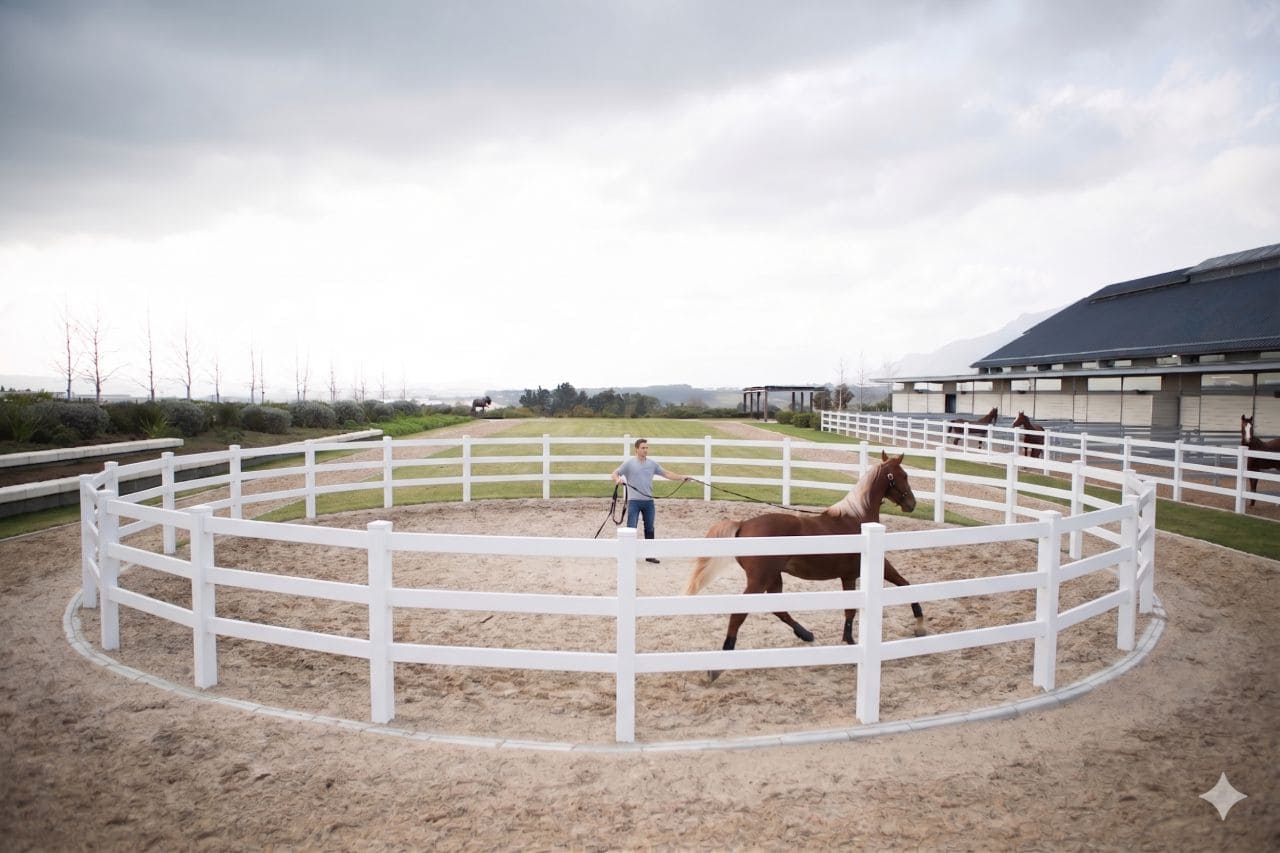
Want to build a round pen? Getting the size wrong is one of the easiest ways to waste money before you even start building.
Buy too many rails, and you’re sitting on unused material. Buy too few, and now you’re dealing with gaps, delays, and a setup that doesn’t function the way it should. It gets worse when the size itself isn’t right. Too small, and your animals can’t move naturally. Too large, and you lose control during training.
The good news is figuring out the numbers doesn’t have to be complicated. Once you understand one simple formula, you can calculate exactly how many rails you need for any round pen size.
In this guide, we break it down step by step, show real-world examples, and give you quick reference numbers so you can plan round pen projects successfully.
Round Pen Calculator Formula
To calculate how many panels and rails you need, use the following formula:
P = (π x D) ÷ L
Let’s break it down:
- P is total panel sections required to complete the circle
- π (pi) is 3.14 and is used to calculate the circumference of a circle
- D is the total diameter (width) of your round pen (in feet)
- L is the length of each panel (commonly 8 ft or 16 ft)
This formula works for any diameter and any panel length, not just standard sizes.
Rounding Up
Always round up to the nearest whole panel. If your result is 23.1 or 23.9, you still need 24 panels. Rounding down will leave a gap and prevent the pen from closing properly.
Rails
Remember that a panel—or a section of the fence—can contain as many rails as you’d like. For example, at Derby Fence, we offer 2-rail, 3-rail, 4-rail, and 5-rail styles.
Gates
If you’re installing a gate, subtract the width of the opening from the total circumference (π x D) before dividing by panel length (L).
Step-by-Step Round Pen Size Calculation Process
Want to double-check your numbers or plan more carefully? Follow these steps:
- Choose your diameter (width) based on how you’ll use the pen.
- Multiply the diameter by 3.14 to get the circumference.
- Subtract gate with if needed.
- Choose your panel length (8 ft or 16 ft).
- Divide the circumference by panel length.
- Round up to the nearest whole number.
After going through this process, you’ll know exactly the number of panels you need to plan for.
Round Pen Examples & Size Breakdown
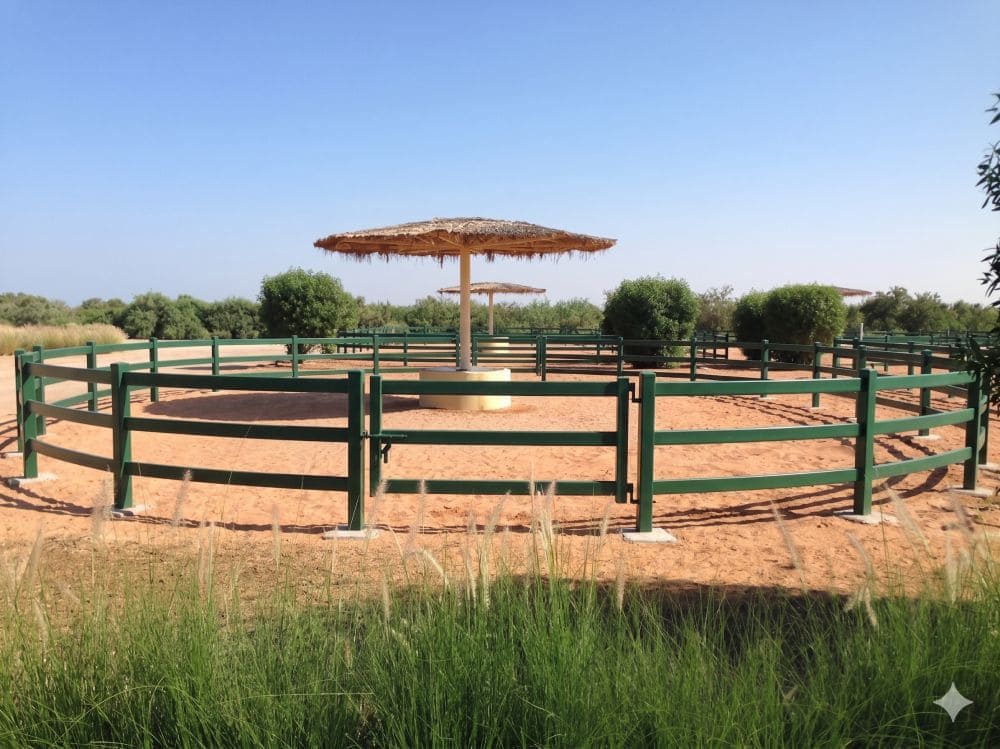
The following examples go through the exact process so you can mirror it for your own setup.
50 ft Round Livestock Corral
Let’s say you want to build a livestock corral with a 50 ft diameter. Here’s how the math works from start to finish:
First, calculate circumference:
50 x 3.14 = 157 ft of total fencing required
Then, divide by panel length:
Using 8 ft panels: 157 ÷ 8 = 19.6
Using 16 ft panels: 157 ÷ 16 = 9.8
Finally, round up:
8 ft panels → 19.6 → 20 panels
16 ft panels → 9.8 → 10 panels
This size of round pen gives you tighter control, which is useful for livestock handling or confined training scenarios. It also keeps material costs low compared to larger diameters.
80 ft Round Horse Arena
If you need more room for movement or training horses, an 80 ft pen is a common setup for horse arenas. Let’s look at the numbers:
First, calculate circumference:
80 x 3.14 = 251.2 ft of total fencing required
Then, divide by panel length:
Using 8 ft panels: 251.2 ÷ 8 = 31.4
Using 16 ft panels: 251.2 ÷ 16 = 15.7
Finally, round up:
8 ft panels → 31.4 → 32 panels
16 ft panels → 15.7 → 16 rails
With this size, you’re trading higher material costs for more flexibility. Horses have more room to move, and the pen can double as a light training or exercise space, but it requires more planning and space on your property.
Common Round Pen Sizes & Panel Requirements
If you want a clearer picture of how size impacts materials, this breakdown shows exactly how panel counts scale as diameter increases.
Diameter (ft) | Circumference (ft) | Number of Panels (8 ft) | Number of Panels (16 ft) |
20 | 62.8 | 8 | 4 |
30 | 94.2 | 12 | 6 |
40 | 125.6 | 16 | 8 |
50 | 157.0 | 20 | 10 |
60 | 188.4 | 24 | 12 |
70 | 219.8 | 28 | 14 |
80 | 251.2 | 32 | 16 |
All values are rounded up and assume a full circle without a gate opening.
Choosing the Right Round Pen Size for Your Needs
The right round pen size comes down to how you plan to use it. Your diameter directly impacts how animals move, how much control you have, and how much you’ll spend on materials.
Smaller Pens (40–50 ft)
Smaller pens give you tighter control over movement, making them a strong choice for groundwork, starting young horses, or working with livestock in confined spaces. They also require fewer panels, which lowers material costs. The tradeoff is limited movement that can restrict more advanced training.
Medium Pens (Around 60 ft)
A 60 ft round pen is the most common setup for a reason. It offers enough space for natural movement while still allowing you to maintain control during training. This size works well for most horse owners and trainers, so it’s the go-to option if you want versatility without overcommitting on space or cost.
Larger Pens (70–80 ft)
Larger pens give animals more room to move freely, and as a result, they’re better suited for advanced training or multi-use setups. However, that added space comes at a cost. You’ll need more panels, more land, and more planning. If you don’t actually need the extra room, you’re just increasing your investment without a clear benefit.
FAQs
What Is the Most Common Round Pen Size?
A 60 ft diameter is the most widely used size for horse training because it balances space and control.
How Many Panels Do I Need for a 60 ft Round Pen?
You’ll need 24 panels at 8 ft length or 12 panels at 16 ft length, assuming no gate adjustment.
Are 8 ft or 16 ft Panels Better?
Longer panels reduce the total number of sections needed, which can simplify installation. Shorter rails can be easier to handle and transport.
Do I Need to Account for a Gate?
Yes. Subtract the width of the gate opening from your total circumference before calculating panel count.
Can I Expand My Round Pen Later?
Yes, but only if you plan for it. Expansion requires additional panels and may affect spacing and layout.
Build the Best Round Pens at Derby Fence
Building a round pen doesn’t require complicated math. Once you understand how to calculate circumference and convert it into panel count, you can plan your entire setup with ease.
Ready to build a round pen for your property? Contact Derby Fence today for a free quote and personalized fencing consultation. Our team is here to help you create a safe, beautiful, and efficient pen with the highest-quality HDPE round pen fencing on the market.